The history of jazz in the United States mirrors a map of human migration and the perpetual search for a place to call home. Ask anyone where this musical genre found its true footing in New York, and most will immediately point to the golden era of 52nd Street or Manhattan’s legendary midtown clubs. Yet the real laboratory—where swing matured and then broke violently into bebop—was tucked away much further north. Don’t believe anyone who claims it all started beneath the neon signs of Midtown. Its real birthplace was in the basements and private brownstone apartments of Harlem. Read on for the full story on manhattan-trend.com.
Why the Sound Took Root in Harlem
The foundation of New York jazz was built on demographics. During the Great Migration (roughly 1915 to 1965), nearly six million African Americans moved from the rural South to northern cities, bringing along spirituals, the blues, and driving church rhythms. In their collective imagination, uptown Manhattan was the ultimate destination. Duke Ellington, who relocated there from Washington, D.C. in 1923, recalled it with absolute clarity:
“Harlem had the most glamorous atmosphere in the world. We just had to go there.”
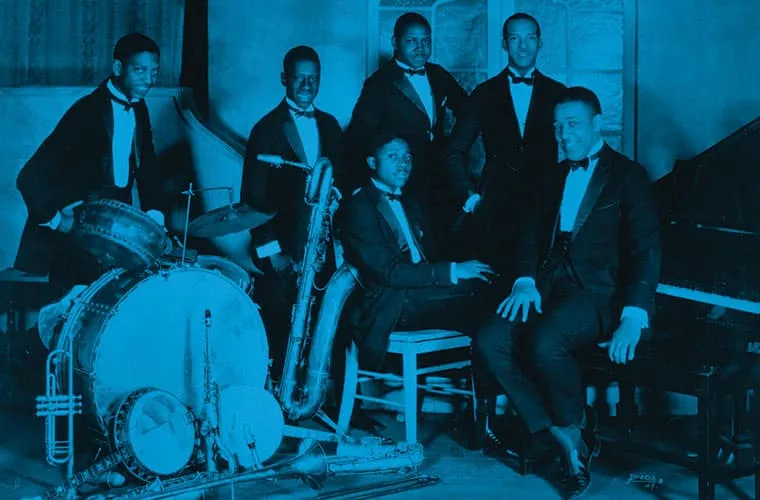
If you picture spacious concert halls echoing with jazz, think again. The primary launchpad for these musicians was the rent party—informal house gatherings where guests paid an admission fee to help the host cover the rent. The rooms were cramped, but this close-quarters intensity gave birth to a revolutionary local piano style: stride, also known as Harlem stride or Eastern ragtime.
The mechanics of stride demanded exceptional technical prowess: the pianist’s left hand leaped relentlessly between low bass notes and midrange chords, while the right hand carried intricate melodies, conjuring the sound of a full orchestra. Pianist Willie “The Lion” Smith recalled how up to a hundred people would pack into a seven-room railroad apartment for these lively sessions.
It was at these house parties that players held legendary cutting contests. James P. Johnson and Willie Smith could trade licks for five straight hours, though Ellington noted it was all done without bad blood—rooted purely in mutual respect. Fats Waller emerged from this crucible, later setting the benchmark for virtuoso Art Tatum. The heartbeat of real jazz back then wasn’t Midtown Manhattan; it was 133rd Street between Lenox and 7th Avenues. Long before 52nd Street gained fame, 133rd was known simply as “The Street.” E. Simms Campbell’s iconic 1932 map captured its staggering nightlife density: roughly a dozen speakeasies and clubs squeezed into just two blocks.
Two Harlems: Dancing for Everyone, Spectating for Whites Only
Harlem’s twin musical worlds offered starkly different listening experiences, building an alternative cultural scene every bit as vital as Off-Off-Broadway would become decades later. The pulse of integrated nightlife beat at the Savoy Ballroom at 596 Lenox Avenue. Opening its doors in 1926, the Savoy welcomed Black and white patrons alike. Its house band, led by Chick Webb, set such an imposing standard that they famously outplayed the Benny Goodman Orchestra in the historic battle of the bands in 1937.
By contrast, the Cotton Club peddled high-society segregation. While Duke Ellington and Cab Calloway made musical history onstage, the audience was strictly white. The venue propelled Ellington to national stardom, yet for years barred Black patrons from sitting at tables. It wasn’t until Ellington personally intervened that tickets were begrudgingly made available to Black patrons—and even then, only in the back rows.
The third pillar of the Harlem circuit was the Apollo Theater on 125th Street. With its legendary Amateur Nights, the theater served as a cutthroat yet extraordinarily effective talent filter. If the Savoy was about dancing and the Cotton Club was an exoticized spectacle for white elites, the Apollo was a launching pad into the professional big leagues. It was here that a 16-year-old Ella Fitzgerald was discovered, landing a spot in Chick Webb’s orchestra right after her winning performance.
A Laboratory, Not a Showroom: Where Swing Fractured into Bebop
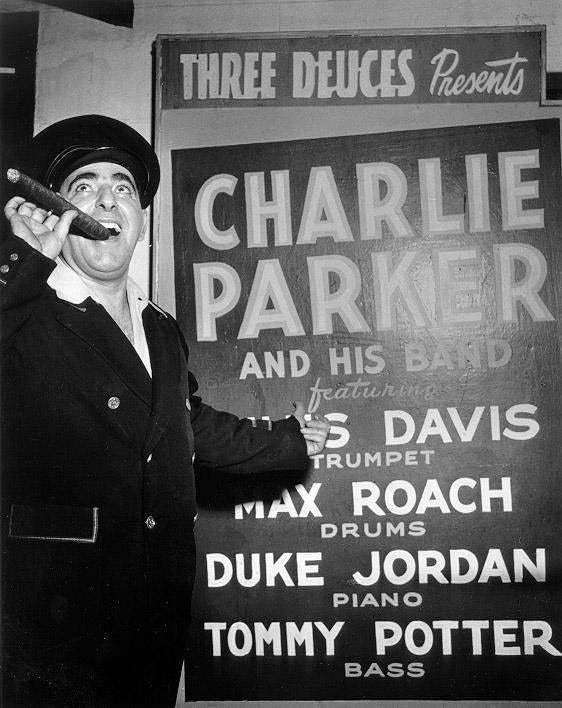
Pop history often claims bebop was born overnight in a single venue. A more accurate truth is that Harlem’s clubs were the private workshop, while 52nd Street eventually became its glittering storefront.
One of the foremost workshops was Minton’s Playhouse at 206 West 118th Street, tucked inside the Hotel Cecil. Founded in 1938 by saxophonist Henry Minton, the venue came into its own around 1940 when manager Teddy Hill hired a core house band: Thelonious Monk on piano, Joe Guy on trumpet, Nick Fenton on bass, and Kenny Clarke on drums.
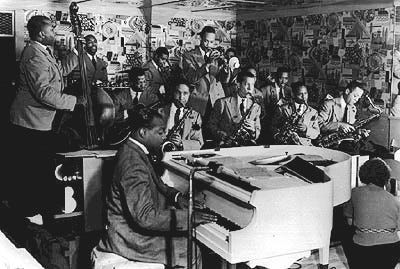
Frequent sit-ins included Dizzy Gillespie and electric guitar pioneer Charlie Christian. When Charlie Parker joined the jam sessions around 1942, Monk and Clarke considered his playing so vital to their evolving sound that they paid the alto saxophonist out of their own pockets.
Retrospective accounts often gloss over a crucial detail: why these radical experiments could unfold here in the first place. The musicians’ union strictly fined players for unauthorized jam sessions. Henry Minton, however, was the first Black delegate of Local 802, meaning union inspectors deliberately turned a blind eye to his club. Nearby, on West 134th Street, a second incubator thrived: Clark Monroe’s Uptown House, whose sessions ran until 1943. Bebop was therefore gestating in at least two places at once.
The music’s soundscape shifted dramatically with World War II, which drained big bands of personnel. Stripped-down basement quintets filled the void. Bebop was meant for listening rather than dancing, making dance floors obsolete: tempos surged to breakneck speeds, harmonies turned dizzyingly complex, and melodies fragmented into agile, jagged runs. Monk’s composition “52nd Street Theme” served as the symbolic bridge—conceived in a Harlem laboratory, its very title pointed toward Midtown, where the revolutionary new musical language had arrived by late 1943.
52nd Street: From Speakeasies to Global Showcase
Popular chronicles often portray the rise of “Swing Street” as near-miraculous—as if jazz simply showed up on 52nd Street one evening and ignited the neon lights. The real infrastructure evolved far more pragmatically. Basements along the block had operated as illicit speakeasies throughout Prohibition, and only after repeal in December 1933 did they gradually convert into legitimate music venues.
Joe Helbock’s legendary Onyx Club had functioned as a speakeasy since 1927 before going legit in 1934 (with Art Tatum holding court during intermissions), surviving multiple fires and relocations along the way. Another powerhouse, the Famous Door, debuted in 1935 and reopened in late 1937. It was so impossibly cramped (holding roughly 60 patrons) that during the Count Basie Orchestra’s residency, the piano had to be pushed right onto the dance floor.
White audiences began migrating down to Midtown following the Harlem riot of March 1935. As historian Harry Berman argued, spooked Cotton Club regulars sought safer pastures for entertainment. Geography did the rest: Broadway’s theaters and CBS broadcasting studios were just around the corner. After finishing commercial gigs, musicians simply walked across the street for late-night jam sessions, while disc jockey “Symphony Sid” broadcast their spontaneous sets live over the airwaves.
The sheer density of clubs meant a listener could traverse jazz history in a single evening: Dixieland revival at Jimmy Ryan’s, classic swing at the Onyx, and revolutionary bebop from Parker and Davis at the Three Deuces. Yet guidebooks conveniently omit an ugly reality: while profiting handsomely off Black brilliance, these clubs systematically excluded Black patrons. Duke Ellington was granted a table only after his white producers intervened, while Billie Holiday and pianist Teddy Wilson were once thrown out of the Famous Door merely for chatting with a white colleague.
The Street’s Demise and What Survives Today
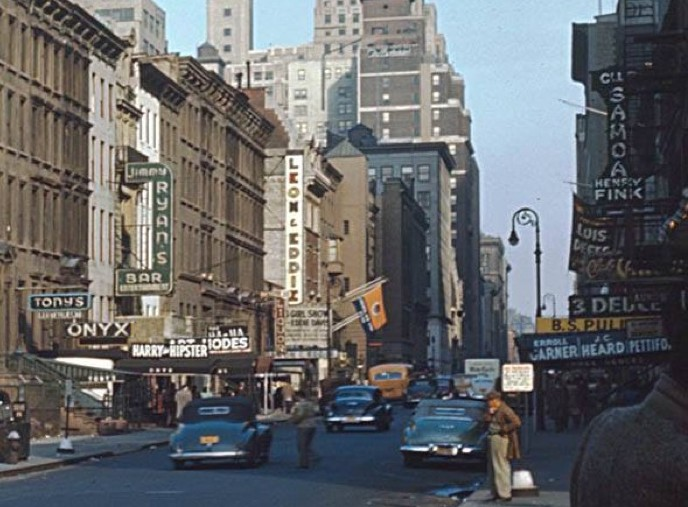
By January 1, 1950, The New York Times practically published an obituary for the strip: live jazz clung to life only at the bop-focused Three Deuces and Dixieland bastion Jimmy Ryan’s. The famed Onyx had degenerated into a strip joint. Heroin, skyrocketing rents, and urban redevelopment delivered the fatal blows. When Jimmy Ryan’s was demolished in 1962 to make way for the CBS headquarters, the club was handed a paltry $9,000 relocation buyout.
The music didn’t die; it simply relocated. In late 1949, the epicenter shifted around the corner to Birdland, a far larger venue on Broadway. The last dedicated jazz venue on 52nd Street folded by 1968, and New York’s creative underground flowed downtown into Greenwich Village.
Today, on the block of 52nd Street between 5th and 6th Avenues, nothing remains of the brownstones that glowed under neon signs in William P. Gottlieb’s iconic 1948 photographs—they were consumed by corporate glass towers. The great irony of New York jazz history is that the authentic walls survived right where it all started: Harlem’s Minton’s still stands on 118th Street, while on 133rd, the basement of Bill’s Place still welcomes music lovers into an authentic Prohibition-era speakeasy.