


This article is about a celebrated American modernist composer who blended elements of American “ultramodernism” with European modernism in his unique style. His orchestral, chamber, solo instrumental, and vocal works are performed worldwide, and he became one of the most revered composers of the second half of the 20th century. We’re talking about the American composer Elliott Carter. Read on to learn more about his childhood, creative development, later years, and achievements on manhattan-trend.
Early Life
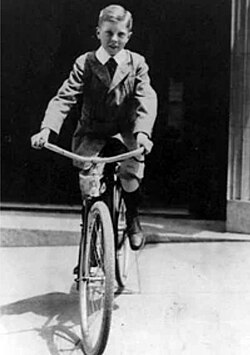
Elliott Cook Carter Jr. was a renowned American composer. He was born on December 11, 1908, in picturesque Manhattan to Florence Chambers and Elliott Carter Sr., a wealthy lace importer. He spent his childhood in Europe and became fluent in French. He started getting interested in music as a teenager, even though his parents didn’t encourage it much, other than providing early piano lessons. A key figure in his musical development was the American modernist composer Charles Edward Ives, who was a family friend. While at Horace Mann School, Elliott wrote a letter to Charles about his musical interests, and Ives responded by urging him to pursue music. From then on, inspired by Charles Edward Ives, the young man continued to study music within the modernist framework.
Ives occasionally took the boy to concerts. Elliott was particularly impressed by the premiere of the ballet and orchestral work “The Rite of Spring,” conducted by Pierre Monteux with the Boston Symphony Orchestra. He later became interested in American ultramodernists like Samuel Conlon Nancarrow, Ruth Crawford Seeger, Edgard Victor Achille Charles Varèse, and Henry Dixon Cowell. After concerts, Ives and Carter Jr. would often discuss and critique what they had heard.
Creative Development and Career Start
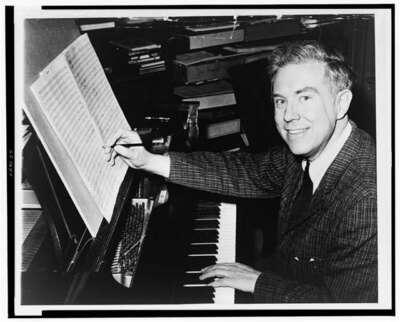
In 1926, Elliott Cook Carter Jr. began his higher education, studying English and music simultaneously. He first took music courses at Harvard and later continued his studies at the Longy School of Music at Bard College. While in college, he sang in the Harvard Glee Club. His teachers included notable figures like English composer Gustav Theodore Holst and American composer Walter Hamor Piston Jr. Carter earned his Master of Music degree in 1932, but the program didn’t significantly advance his compositional skills. So, he moved to Paris to study with the famous French music teacher, Juliette Nadia Boulanger. In 1935, Carter returned to the United States and began writing music for the “Ballet Caravan.” His works from this period included ballets like “Pocahontas” and “The Minotaur,” which became some of his longest compositions written in a neoclassical style.
In 1940, Elliott Carter began teaching, first at St. John’s College, then at the Peabody Conservatory, Columbia University, Queens College, Yale University, Cornell University, and the Juilliard School. During World War II, he worked for the Office of War Information.
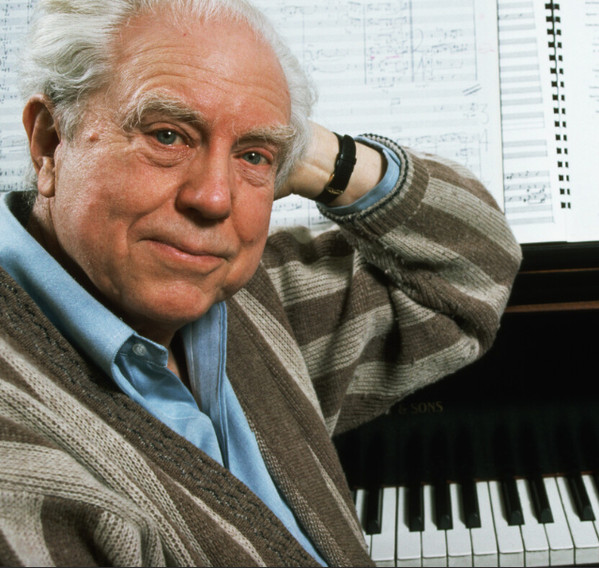
Over time, Elliott started returning to his avant-garde experiments, but after the war, he sought a new way of musical expression. Key works from this period include “Cello Sonata,” “First String Quartet,” and “Variations for Orchestra.” Soon after, Elliott Carter was recognized as a leading 20th-century composer. Carter continued to write music every morning until his death on November 5, 2012. The prominent American composer passed away in his New York home at the age of 103.
Awards and Achievements
Throughout his life, the composer gifted the world with a lot of beautiful music that is still performed today. Some of his notable musical works include “Night Fantasies,” “Caténaires,” Symphony: sum fluxae pretium spei, A Symphony of Three Orchestras, Cello Sonata, Sonata for Flute, Oboe, Cello and Harpsichord, Duo for Violin and Piano, and Triple Duo, among others. The composer also received numerous awards, including the Ernst von Siemens Music Prize, the Edward MacDowell Medal, the National Medal of Arts, the Thomas Jefferson Medal, and many others.