


Manhattan’s Theater District is brimming with venues offering cultural entertainment for every taste and preference. Among them is the Circle in the Square Theatre – a Broadway theater and, simultaneously, an acting school right in the heart of Times Square. More on manhattan-trend.com.
History
The first Circle in the Square Theatre opened in 1951 on Sheridan Square. The theater’s name was inspired by its seating arrangement, which formed a circle around the stage. Throughout the 1950s and 1960s, the theater was an Off-Broadway venue (Manhattan spaces of this kind seat between 100 and 499 people). Its first production was “Dark of the Moon” by Howard Richardson and Richard Berney, presented in 1951. Back then, a ticket cost $1.50. Subsequently, city authorities designated the Sheridan Square space as a cabaret, so tables were set up around the stage, and audiences were served cookies and punch to meet cabaret requirements.
The theater was temporarily closed from 1954 to 1955, and in 1960, the building was demolished. The company later presented shows at various locations. The current venue in Times Square, located in the basement of the Paramount Plaza skyscraper, opened its doors in 1972. The upper part of the auditorium features soundproofing panels, which were installed to minimize noise, including from horses, when the theater first opened. In the 1970s and 1980s, it staged an average of 3-4 shows per year. After declaring bankruptcy in 1997, the theater reopened two years later.
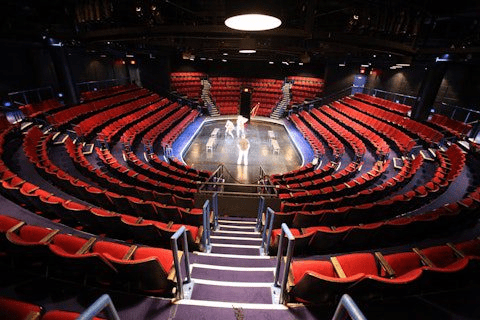
The space features a thrust stage, meaning it’s positioned in the middle of the audience rather than in front of it, while still connected to the backstage area. Audience seating surrounds it on three sides. It’s one of only two Broadway theaters with this stage type, the other being the Vivian Beaumont Theater. Due to this unconventional stage design, theater critics often view such spaces negatively, and directors find it challenging to stage productions on thrust stages. However, the unique setup allows audiences to watch the actors’ performances up close. Interestingly, the design of the current Circle in the Square Theatre was based on its predecessors. These, in turn, were built according to the recommendations of theater critic Brooks Atkinson. He believed that when a person enters a theater, they should primarily see the stage, not the audience.
Atypical Repertoire
Since its inception, Circle in the Square Theatre has offered America’s finest actors the chance to work in an environment free from commercial pressures. The theater has always encouraged them to make bold choices and has catered to performers’ desires to explore plays outside the mainstream repertoire. Circle in the Square Theatre presents shows not typically staged on Broadway, allowing audiences to experience challenging material unavailable elsewhere.
During the 1960s, Circle in the Square Theatre was renowned for reviving classics like “Othello” and “Iphigenia in Aulis.” It also showcased new and experimental works, such as Jean Genet’s “The Balcony” and Brendan Behan’s “The Quare Fellow.”
Throughout its long history, the theater has launched the careers of many playwrights, actors, and directors. Notable figures who have worked on productions here include Al Pacino, George C. Scott, Tennessee Williams, Thornton Wilder, Audra McDonald, Geraldine Page, James Earl Jones, Mary-Louise Parker, Vanessa Redgrave, and Norm Lewis.
Educational Opportunities
Since 1961, the Circle in the Square Theatre School has been training actors for professional careers. The school was legally separated from the theater itself in 1993 and has since operated as a non-profit organization. It is the only accredited training conservatory associated with a Broadway theater. It offers two 2-year programs in acting and musical theater: the Acting Track and the Musical Theatre Track. Additionally, summer workshops are available, as well as a joint bachelor’s degree program with Eckerd College (Florida).
The school participates in student exchange programs. It collaborates with the community on joint artistic projects and performances. Famous alumni include actor, producer, and director Kevin Bacon, as well as actor and director Philip Seymour Hoffman.
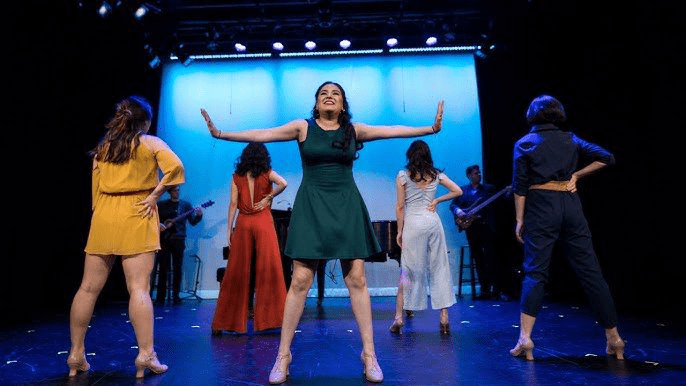
The institution provides all the necessary tools for students to succeed in the theater industry and adapt to an ever-evolving field. Students in both 2-year programs gain maximum exposure to acting techniques, creative approaches, and artistic development practices. In addition to core classes on contemporary and Shakespearean scenes, all students study improvisation, voice and speech, acting technique, film acting, ballet, jazz dance, music theory, and more.
The skills acquired here help actors develop versatility. At the same time, each student cultivates their own unique artistry and technique. When the school was founded, it had only 15 students. By the 2020s, this number had grown to approximately 150.